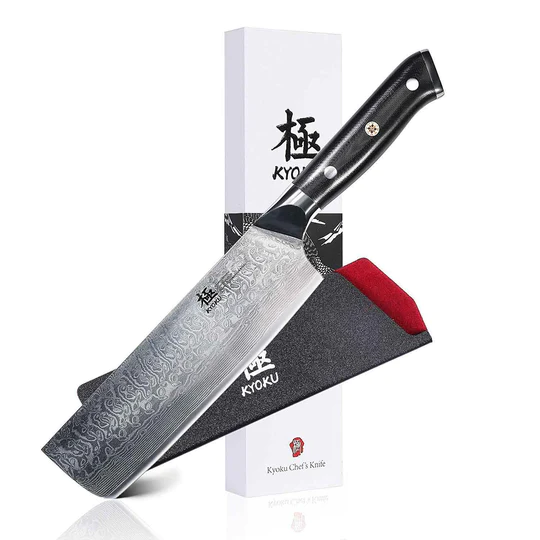
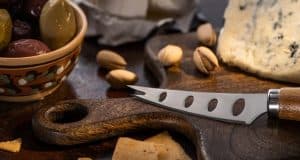
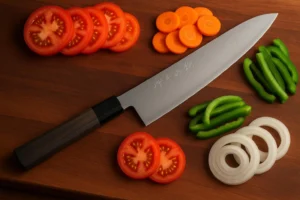
Cutting onions doesn’t need to end in tears and uneven pieces. The wrong knife can crush onion cells, making them release more enzymes that cause crying. It can also create uneven pieces that cook at different rates.
The right knife makes this kitchen task quick and easy. This Knife Buzz guide will help you choose the best all round knife for cutting onions and other vegetables.
A Chef’s knife with an 8-inch blade offers the perfect balance of length, sharpness, and control for clean cuts. The curved blade design lets you use a rocking motion when chopping. This motion helps you dice onions quickly and evenly without lifting the knife tip off the cutting board.
Most professional chefs use a Chef’s knife as their go-to tool for onion prep. These knives have flat blades that slice smoothly through onion layers without crushing the delicate structure. This reduces the release of compounds that make your eyes water.


Santoku knives offer excellent versatility and work well for fine dicing. Santokus measure 5-7 inches, making them easier to control than longer Chef’s knives. The shorter blade gives you better precision when making small, uniform cuts.
The Santoku’s flat cutting edge makes clean contact with your cutting board. This creates more consistent results than curved blades. The dimpled blade surface also helps onion pieces fall away cleanly. You won’t need to stop and scrape sticky onion slices off your knife.

Professional chefs often choose Gyuto knives for onion work. These knives deliver precise control over cut size and shape. A laser Gyuto or a lighter Western Chef’s knife makes it easy to dice onions and move on to other tasks without switching knives.


Paring knives excel at removing onion skins and making precise cuts. You can easily maneuver the small 3-4 inch blade around the onion’s curved surface. This makes skin removal much faster than with larger knives.
The pointed tip helps you pierce the onion skin without damaging the flesh underneath. You can then lift away papery layers in one piece.

For small amounts of onion, a Paring knife provides good control. However, the short blade requires more cuts to dice a whole onion. This increases your prep time compared to longer knives.
Paring knives become inefficient when cutting multiple large onions. Larger knifes are also needed for large root vegetables.
The best uses for Paring knives include:

Mezzalunas excel at quick chopping and minces onions faster than traditional knives. Both hands control the blade, giving you more power and stability. You rock the blade back and forth to chop onions quickly and uniformly.
The curved design keeps the blade in contact with your cutting board in a rocking motion. This creates more consistent cuts than lifting and chopping.
You can adjust the fineness by changing your rocking speed and pressure. Quick, light motions create coarse chops while slower, firmer pressure produces fine mince.
Single-blade Mezzalunas work well for home kitchens. Double-blade versions provide better control and can chop faster, but they require more storage space.
Key advantages include:

The right knife for cutting onions depends on three main factors. You need a blade that cuts cleanly through onion layers, a comfortable handle for safe control, and sharp steel that won’t crush the vegetable’s cells.
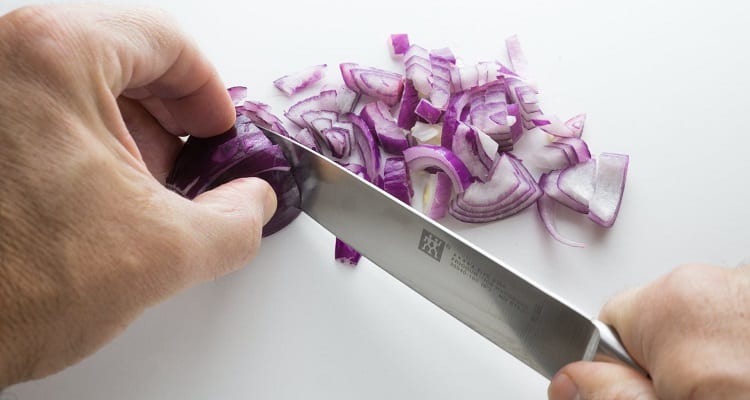
A Chef’s knife with an 8 to 10-inch blade works best for most onion cutting tasks. The curved edge lets you rock the blade through onions smoothly. This motion helps you dice quickly and evenly.
Santoku knives also work well for onions. They have a flatter edge that’s good for straight chopping motions. The blade is usually 5 to 7 inches long, which gives you good control.
The right knife makes all the difference in how easily you can slice through onion layers. Your knife blade should be wide enough to guide your knuckles safely. A blade that’s at least 1.5 inches tall protects your fingers as you cut.
Avoid serrated knives for onions. The teeth can tear the onion and make your cuts uneven. A smooth, straight edge gives you clean cuts every time.
Your knife handle should feel secure in your hand. A comfortable grip prevents accidents when your hands get wet from onion juices. Look for handles made from materials that won’t slip.
Textured handles give you better control than smooth ones. Many good onion knives have handles with small ridges or patterns. These help you hold the knife firmly even when your hands are damp.
The handle size matters too. It should fit your hand without being too thick or too thin. A handle that’s too big makes the knife hard to control. One that’s too small can cause hand cramps during long prep sessions.
Weight balance is important for comfort. The knife shouldn’t feel too heavy at the blade or too light at the handle. Sharp blades and comfortable handles help reduce effort when cutting onions.
Sharp knives are safer and work better for onions. A dull blade crushes onion cells instead of cutting them cleanly. This releases more of the compounds that make your eyes water.

High-carbon stainless steel makes the best onion knife blades. This material holds a sharp edge longer than regular stainless steel. It also resists rust and stains from onion acids.
German and Japanese steel are both excellent choices. German steel is usually harder and holds its edge well. Japanese steel can be sharpened to a finer edge but may need more care.
Test sharpness by slicing paper. A sharp knife should cut through paper cleanly without tearing it. If your knife tears the paper, it needs sharpening before you use it on onions.
Using a sharp knife while making slow, controlled cuts minimizes the spray of tear-producing compounds in onions. This reduces the amount of irritating gases released.
Dull knives crush onion cells instead of cutting them cleanly. This releases more sulfur compounds that make your eyes water.
The best knife for dicing onions should have a sharp, stainless steel blade that’s around 8 to 10 inches long. This length gives you enough blade surface to handle medium and large onions easily.
Look for stainless steel blades that also do not retain debris as you slice, providing a clean cut. The smooth surface prevents onion pieces from sticking to the blade.
For smaller onions, you can also use a sharp Paring knife with a blade between 2-4-inches. Paring knives work well for peeling and removing the outer layers too.
In addition the brands listed above, All-Clad makes quality Chef’s knives that work well for onion cutting. Place your onion on a clean cutting board. With your All-Clad Chef’s Knife, trim 1/4 inch from the stem end.
Dalstrong offers knives with high carbon German steel construction. Their blades are precision forged, ultra sharp, single-piece, high carbon German ThyssenKrupp Steel at 56+ Rockwell.
Comfortable handles reduce hand fatigue during long prep sessions. This helps you keep better control and cutting technique. Wooden handles are often best and prevent slipping during wet cutting tasks. Wood provides a natural grip even when your hands get damp.
The handle should fit your hand size. Handles that are too large or too small can cause strain and reduce cutting precision. Balanced knives with proper handle design also make onion cutting easier. The weight should feel natural in your grip.